Shuchismita Anwar
Researcher in Artificial Intelligence, Machine Learning, and Computer Vision
Advancing intelligent systems at the intersection of computational imaging, large language models, and multimodal AI through rigorous research and development.
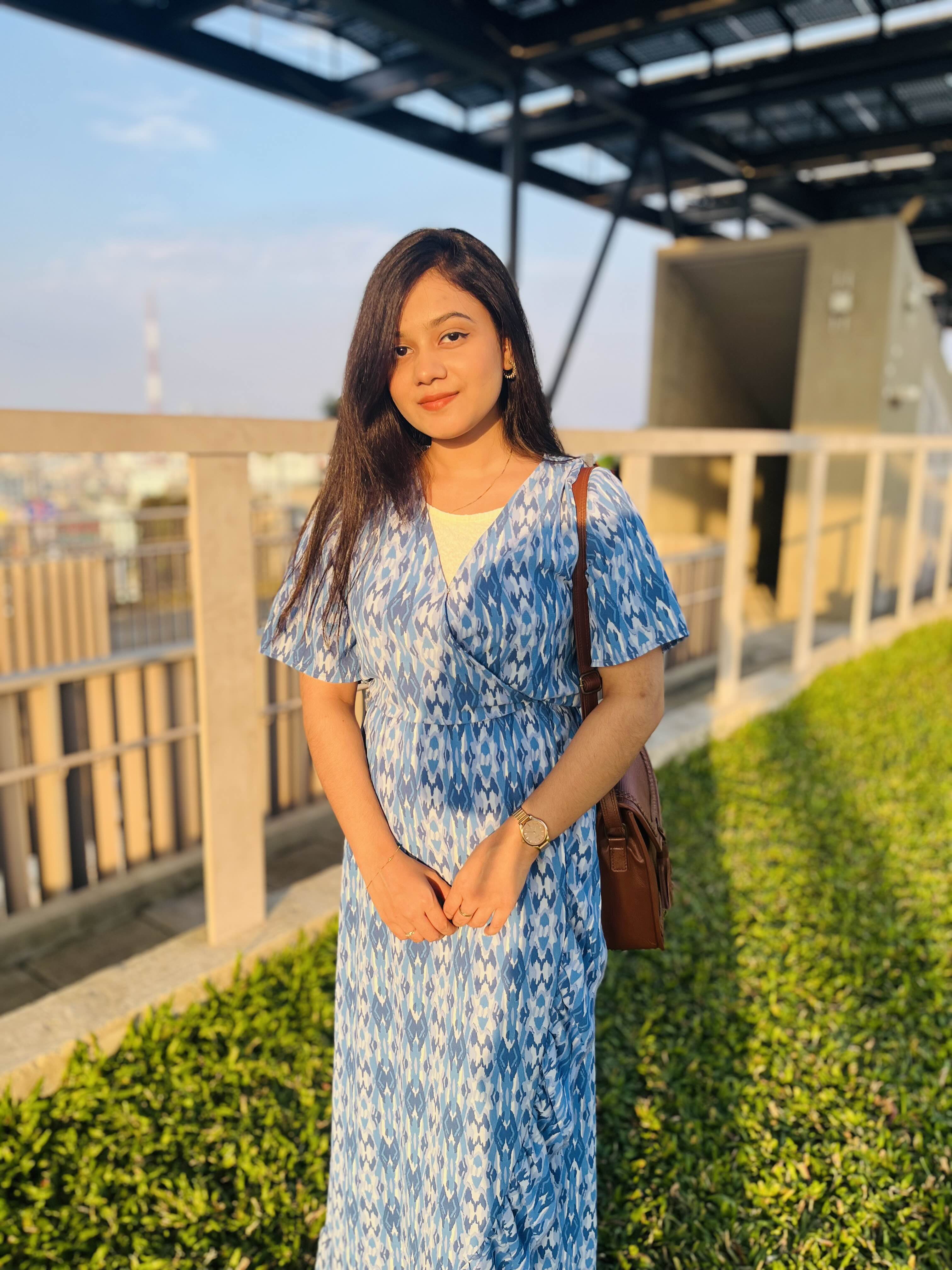
About
I am a researcher in artificial intelligence with a strong background in machine learning, and multimodal learning. My work explores how computational models can be made more efficient, interpretable, and impactful, with applications ranging from multimodal learning to medical data analysis.
Currently, I serve as a Graduate Research Assistant at BRAC University, contributing to projects on quantum-classical hybrid models, medical imaging, multimodal report generation, and lightweight neural architectures. These experiences have allowed me to work across theory and application, strengthening both my technical expertise and my research vision.
I am preparing to pursue a Ph.D. in artificial intelligence and machine learning, with the goal of advancing methods that are both theoretically grounded and practically meaningful.
Publications
Tanjim Islam Riju*, Shuchismita Anwar*, Saman Sarker Joy, Farig Sadeque, Swakkhar Shatabda
We propose a two-stage multimodal framework that integrates chest X-ray images, clinical labels, bounding boxes, and radiologist gaze data. A novel gaze-guided contrastive learning model improves disease classification (F1 ↑ 5.7%, AUC ↑ 3.4%), while a region-grounded report generation pipeline produces more accurate and interpretable radiology reports.
Shuchismita Anwar, Sowmitra Das, Muhammad Iqbal Hossain, Jishnu Mahmud
This work introduces a hybrid quantum-classical QCNN that reuses qubits discarded during pooling to preserve entanglement information often lost in conventional architectures. By coupling these recycled qubits with classical layers through joint optimization, the model achieves significantly higher accuracy on MNIST, Fashion-MNIST, and OrganAMNIST, while maintaining a lightweight parameter footprint compatible with NISQ hardware.
Projects
Built an end-to-end object detection system on Pascal VOC 2012, combining EfficientNet with a YOLO-style architecture. Implemented custom data preprocessing, augmentation, and loss functions, with optimized training and evaluation on COCO images. The framework outputs accurate bounding boxes and class predictions with visualization support.
Deep learning framework using graph neural networks to predict drug-target interactions. Features web interface for researchers to query potential drug candidates.
Built an end-to-end emotion detection system (angry/happy/sad) with TensorFlow/Keras, spanning custom LeNet/ResNet34, EfficientNet/MobileNetV2 transfer learning, and Vision Transformers (custom ViT + HuggingFace ViT). The pipeline includes tf.data loaders, on-the-fly augmentation (RandomFlip/Rotation/Contrast, optional CutMix), W&B experiment tracking, and explainability via feature-map visualizations and Grad-CAM. Models were exported to ONNX and TFLite, with quantization and pruning for speed/size gains, plus TFRecords for scalable I/O and a simple model ensemble for higher accuracy. The result is a reproducible classification stack with training, evaluation, and deployment benchmarks.
Built a class-balanced PneumoniaMNIST classifier using PyTorch with on-the-fly oversampling, a compact CNN (~21k params), and rigorous evaluation (ROC, PR, confusion matrix). Training for 30 epochs reaches 94–95% validation accuracy and 85.4% test accuracy with precision 0.84, recall 0.95, and F1 0.89. The codebase also prototypes a differentiable Qiskit circuit layer (parameter-shift gradients) integrated via a custom autograd.Function, explored as a plug-in feature extractor alongside the classical pipeline.
Experience
Contributing to research in multimodal AI and lightweight neural architectures. Involved in literature reviews, experimental design, publication writing, and guiding undergraduate thesis students.
Mentored students through labs, graded assignments, and provided guidance during office hours, deepening both my subject mastery and my ability to communicate complex concepts clearly.
Education
Bachelor of Science in Computer Science & Engineering
BRAC University • 2020 - 2024
Highest Distinction